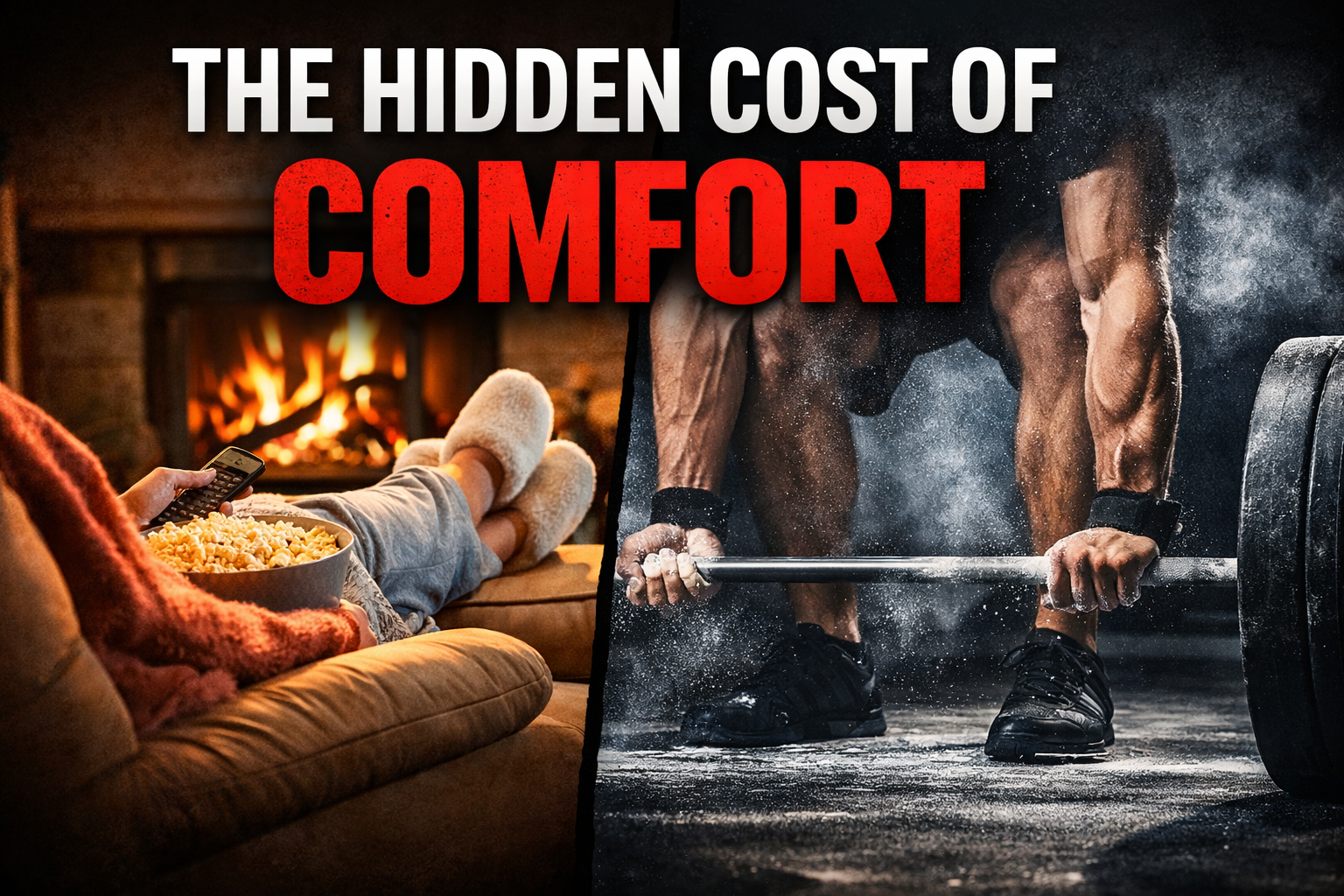
We have made life too easy, and it is starting to show.
Most of what used to require effort has been engineered out of our daily lives. We control temperature with a button. Food is always available. Work is increasingly sedentary. Even inconvenience has been reduced to a minor annoyance rather than a real disruption.
On the surface, this looks like progress. In many ways, it is. But there is a side of this equation that we do not talk about enough.
As comfort has increased, our capacity has declined.
You can see it physically. People are weaker, less durable, and more prone to fatigue. But it is not just physical. It shows up psychologically and inside organizations as well. Lower tolerance for stress. Difficulty handling pressure. A tendency to avoid anything that feels hard.
This is not a coincidence. It is how the human system works.
The body does not respond to comfort. It responds to stress.
If you want strength, you have to give the body a reason to build it. Muscle does not grow because you want it to. It grows because it is forced to. Bone density improves under load. The cardiovascular system becomes more efficient when it is pushed beyond what is comfortable.
Remove that demand, and the body starts shutting down capacity that it no longer needs.
This is what antifragility really means. The body does not just tolerate stress. It requires it to improve. Without it, you do not stay the same. You decline.
That is the part most people underestimate.
Comfort is not neutral. It is a slow erosion of capability.
Michael Easter makes this point clearly in The Comfort Crisis. When humans remove challenge from their environment, they do not become more at ease. They become less capable. The range of what they can handle shrinks. And when that range shrinks, even normal levels of stress begin to feel overwhelming.
The same pattern shows up in the mind.
You do not build resilience by avoiding difficulty. You build it by going through it. But most people today are doing the opposite. They avoid hard conversations. They avoid physical strain. They avoid uncertainty. Then they wonder why small problems feel big.
This is not about personality. It is about exposure.
When you are not regularly challenged, your tolerance drops. Things that used to be manageable start to feel like pressure. Feedback feels personal. Deadlines feel aggressive. Accountability feels unfair.
The world did not get harder. Your capacity to handle it got smaller.
This is where leaders start to feel the tension.
They want high performance, but they are leading teams that have been conditioned for comfort. Pressure feels like a problem instead of a necessary condition. So leaders start adjusting the environment. They soften expectations. Delay decisions. Dilute feedback. Avoid conflict.
It makes things feel better in the short term. But it comes with a cost.
Over time, the organization adapts to a lower standard of performance. Not because people are incapable, but because they are underexposed to the kind of stress that builds capability.
You do not build strong teams by protecting them from difficulty. You build them by leading them through it.
That does not mean all stress is good. There is a difference between productive stress and destructive stress. Chronic pressure without recovery will break people down. Poor leadership that creates confusion or instability does not build resilience. It creates burnout.
But the absence of stress is not the solution. The right kind of stress is.
Productive stress is intentional. It stretches people without overwhelming them. It creates pressure with purpose. In the body, that looks like training followed by recovery. In organizations, it looks like high standards paired with clarity and support.
The problem today is not just that people experience stress. It is that many are exposed to the wrong kind while avoiding the kind that actually makes them stronger.
This is where leadership matters.
Leaders set the tone for what is expected and what is avoided. Every time you lower the bar to make things easier, you train your team to expect less of themselves. Every time you avoid a hard conversation, you reinforce avoidance. Every time you remove pressure, you reduce capacity.
There is no neutral here. You are either building strength in your people or you are eroding it.
If comfort is the default, then growth has to be intentional.
That starts at the individual level. Do something that requires effort. Lift. Move. Carry weight. Put your body in situations where it has to respond. Not occasionally, but consistently. Physical weakness has a way of showing up in other areas whether we admit it or not.
The same applies psychologically. Have the conversation you have been putting off. Take on work that stretches you. Put yourself in situations where the outcome is not guaranteed. Stop insulating yourself from discomfort.
For leaders, the responsibility is even greater. Set standards and hold them. Give direct feedback. Expect effort. Do not apologize for creating challenge when it serves growth. At the same time, provide clarity and support so that the stress you introduce actually builds people instead of breaking them down.
This is not about making things harder for the sake of it. It is about restoring the conditions under which people perform at their best.
At some point, you have to accept the tradeoff.
You can have comfort, or you can have capability. You do not get both at a high level.
Comfort feels good in the moment. It removes friction and effort. But over time, it weakens the very systems you rely on to perform.
Capability is built through strain. Through effort. Through doing things that are uncomfortable on purpose. It produces strength, resilience, and confidence that cannot be faked.
The modern world has made comfort easy to access. That is not going to change.
What has to change is how you respond to it.
Because if you do not deliberately introduce challenge into your life and your leadership, comfort will do what it always does.
It will make you weaker.


His information is both provocative and engaging. His speeches can be an emotional roller-coaster with the audience laughing one minute and holding back tears the next. Energy and passion are the two most common words used to describe John Grubbs as a speaker and trainer.
DUNS: 805555781
CAGE: 8EMN3
Primary NAICS: 611430

PSST, CAN YOU KEEP A SECRET? WE CAN'T...
Do you work with idiots? Get a free copy of my book to survive...

|
It's a humorous book on Servant Leadership that sells for $20 bucks on Amazon. |